Best Meat Thermometer Under $25 for Dads Who Eyeball Everything
I ruined a $40 ribeye on Memorial Day. Pulled it off the grill confident it was medium-rare, cut into it twenty minutes later, and it was a sad shade of gray-brown. My wife didn’t say anything. The look was enough.
That was the moment I admitted I’d been eyeballing meat doneness for fifteen years and getting away with it most of the time, but not all of the time. The next morning I bought four instant-read thermometers under $25 and vetted every one of them on burgers, steaks, chicken thighs, and a pork shoulder.
Here’s what’s actually worth your money, what’s overhyped, and why you don’t need to spend $99 on a Thermapen to cook meat correctly.
Our Top Picks
- TempPro TP19H Waterproof Digital Meat Thermometer — Best overall under $25. 1-second read, IP65 waterproof, foldaway probe. ~$15–$22.
- TempPro TP19 Thermocouple Instant Read — The professional-grade option. 2–3 second read with thermocouple sensor. ~$22–$28.
- Alpha Grillers Instant Read Meat Thermometer — The budget workhorse. 3-second reads, IP67 waterproofing, magnetic back, usually around $13.
Why an instant-read thermometer is the cheapest cooking upgrade you’ll ever make
I don’t say this lightly: a $20 thermometer will save you more steaks per year than any other tool in your kitchen. Here’s the math.
A bad ribeye costs $35–$50 at the meat counter. Overcook it once, that’s the price of two thermometers. Most dads do this 4–6 times a year without realizing it. The thermometer pays for itself the first weekend you use it.
The reason eyeballing fails is simple: ambient temperature, meat thickness, and starting temperature all vary. Five minutes per side is right for one cut and wrong for the next. The poke test (pressing the meat and comparing it to the meat between your thumb and palm) is roughly accurate but assumes everyone has the same hand stiffness, which they don’t.
Internal temperature is the only thing that’s true regardless of variables. 130°F is medium-rare whether the steak is one inch or two inches thick.
What separates a good thermometer from a bad one?
Three specs matter:
Speed. How fast does it read? Fast thermometers (1–3 seconds) mean you barely open the grill, which means the temperature inside the grill stays stable. Slow thermometers (8–15 seconds) defeat the purpose because by the time you get a reading, the heat has dropped.
Accuracy. Most decent thermometers are accurate to ±1°F or better. The cheap ones at the bottom of the gas station aisle can be off by 5–10°F, which is the difference between rare and medium.
Waterproofing. Grilling in the rain, washing the probe under the tap, dropping it into a marinade — all of this happens in real life. IP65 or IPX6 waterproofing is the floor. Anything less and you’ll fry the electronics within a year.
Best meat thermometer under $25 overall: TempPro TP19H
The TempPro TP19H is the one I use now. It reads in about 1 second, is accurate to ±0.9°F, has IP65 waterproofing, and folds shut for storage. The probe locks open at 180 degrees, which is the right angle for getting into a thick brisket without burning your knuckles on the grate.
The auto-rotating display is the feature I didn’t know I needed. Whether you grab the unit upside-down or right-side-up, the screen flips so the numbers are oriented correctly. Sounds gimmicky. Saves you about three seconds of fumbling every time you pull it out, which adds up over a long cookout.
Battery life is the other selling point: TempPro rates it at 3,000 hours on a single AAA. I’ve owned mine for fourteen months and haven’t changed the battery yet. Not a typo.
Note: TempPro is rebranding to “TempPro” — the same products are showing up under both names on Amazon depending on stock. The product is identical.
Pros
- 1-second read time, ±0.9°F accuracy
- IP65 waterproof — rinse it under the tap, no problem
- Auto-rotating backlit display works in low light or upside-down
- Magnetic back sticks to your grill or fridge
- Folding probe protects the tip when stored
Cons
- Plastic body feels less premium than $80 thermometers
- The fold action loosens slightly after heavy use (still works, just less satisfying)
- Magnetic back loses some grip if grease builds up — wipe it clean monthly
Who should skip it?
Skip if you’re a competitive BBQ guy who needs sub-second readings on multiple probes simultaneously — get a multi-probe Bluetooth setup instead. Skip if you cook indoors only and never need waterproofing; you can save $5 on a non-waterproof model. Skip if you really care about Made-in-USA branding; this is made overseas like most thermometers in this price range.
Step-up pick: TempPro TP19 (Thermocouple Sensor)
The TempPro TP19 uses a thermocouple sensor instead of the thermistor in the TP19H. The difference: thermocouples are what professional kitchen thermometers (the $99 Thermapen) use. They’re slightly faster (2–3 seconds), more durable over time, and more accurate at extreme temperatures.
For the average home grill cook, the upgrade isn’t necessary. For someone smoking briskets on a 14-hour cook, doing reverse sears, or working at deep-fry temperatures (375°F+), the thermocouple sensor matters because thermistor sensors lose accuracy as temperatures climb above 400°F.
It runs $5–$10 more than the TP19H. Same form factor, same waterproofing, same display. Just better internals.
Pros
- Thermocouple sensor — same tech as $99 thermometers
- 2–3 second read time with ±0.9°F accuracy across full temp range
- More accurate than the TP19H above 400°F
- Same waterproof, motion-sensing, magnetic-back features
Cons
- $5–$10 premium over the TP19H for benefits most users won’t notice
- Pushes the budget close to $25–$28, sometimes over
- Same plastic body as the cheaper version
Who should skip it?
Skip if you mostly grill burgers, steaks, and chicken at typical grilling temps (under 400°F). The TP19H reads everything you’ll ever cook just as accurately. Skip if budget matters more than thermal-physics correctness.
The budget pick: Alpha Grillers Instant Read
The Alpha Grillers Instant Read Meat Thermometer The Alpha Grillers Instant Read Meat Thermometer is the budget workhorse pick. It reads in about 3 seconds, is IP67 waterproof, has a backlit display, and a magnetic back. For around thirteen bucks, it is the kind of tool that saves one steak and pays for itself immediately.
Pros
- IP67 waterproof — best water rating in this price range
- 3-second reads with backlit display
- Magnetic back for hands-free storage
- Around $13 — lowest price point in the roundup
Cons
- Slightly slower than the TempPro TP19H (2–3 sec vs 1 sec)
- Hold button is a separate press (not motion-activated)
- No foldaway probe — fixed probe style
Who should skip it?
Skip if you want the absolute fastest read time available — the TP19H is 1–2 seconds quicker. Skip if you don’t care about the gift box and just want raw performance per dollar. Skip if you cook outdoors in heavy rain often; the IP rating isn’t as strong.
Comparison table
| Product | Price | Best For | Who Should Skip It |
|---|---|---|---|
| TempPro TP19H | ~$15–$22 | Best overall. 95% of grill cooks should buy this. | Brisket smokers needing 400°F+ accuracy. BBQ competitors. |
| TempPro TP19 (Thermocouple) | ~$22–$28 | Smokers, reverse-sear cooks, deep-fryers needing high-temp accuracy. | Casual cookers. Anyone optimizing strictly for budget. |
| Alpha Grillers Instant Read | ~$13 | Budget-conscious grill cooks. Anyone who wants waterproofing without paying $20+. | Speed obsessives who need 1-second reads. Anyone wanting a foldaway probe. |
What temps to actually hit
Print this out, tape it to your grill. Memorize over time. Pull the meat 5°F below the target temp because it’ll keep cooking while it rests.
| Meat | Doneness | Pull Temp | Final Temp After Rest |
|---|---|---|---|
| Beef steak | Rare | 120°F | 125°F |
| Beef steak | Medium-rare | 125°F | 130°F |
| Beef steak | Medium | 135°F | 140°F |
| Beef steak | Medium-well | 145°F | 150°F |
| Burgers (ground beef) | USDA safe | 160°F | 160°F |
| Chicken (any cut) | USDA safe | 165°F | 165°F |
| Pork chops/loin | Medium | 140°F | 145°F |
| Pork shoulder/butt | Tender (probe slides in) | 200°F+ | — |
| Brisket | Tender (probe slides in) | 203°F | — |
Round out the grill setup
If you’re shopping for a thermometer, you’re probably 80% of the way to a complete grill upgrade. The other tools that complete the kit are sub-$30 each:
- Heavy-duty tongs. Spring-loaded with a locking mechanism. The flimsy ones at the supermarket are useless.
- A long-handled metal spatula. Long handle keeps your hand off the heat. Look for ones with a beveled edge for sliding under crusty burgers.
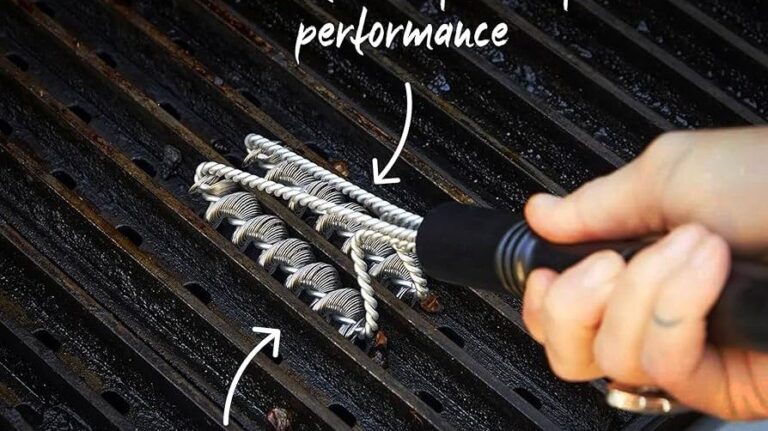
- A quality grill brush. Bristle-free is non-negotiable in 2026 — read the brush article for details.
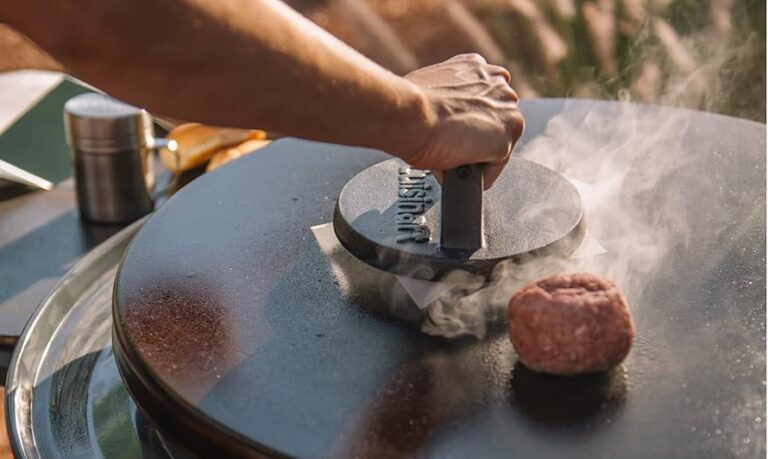
- A good cast iron skillet for the grill. [IMPACT: Sportsman’s Guide — Camp Chef cast iron skillet] turns your grill into a flat-top for smash burgers, fajitas, and crispy chicken thighs.
Related: For the brush side of the kit, I’d start with the best bristle-free grill brush for safe grilling guide. A thermometer fixes the guessing problem. A bristle-free brush fixes the “tiny wire near dinner” problem.
Related: If the flat-top plan is really about burgers, the other cheap upgrade is a smash burger press under $30. Press, thermometer, hot surface. That is the whole cheat code.
A complete grilling kit including all of the above plus the TempPro TP19H runs about $80 total. That’s the entry point to actually cooking meat correctly. Everything past that is preference.
FAQ
Is a $20 meat thermometer as accurate as a $99 one?
For typical grilling temperatures (under 400°F), yes. The TempPro TP19H reads accurate to ±0.9°F, which is the same accuracy as the Thermapen ONE that costs $99. The differences at the higher price point are speed (Thermapen reads in under 1 second consistently), build quality (metal body, splash-proof seals), and resale value (Thermapens hold their value for years). For a home cook making four steaks on a Saturday, the $20 option does the same job.
Where do I stick the probe in the meat?
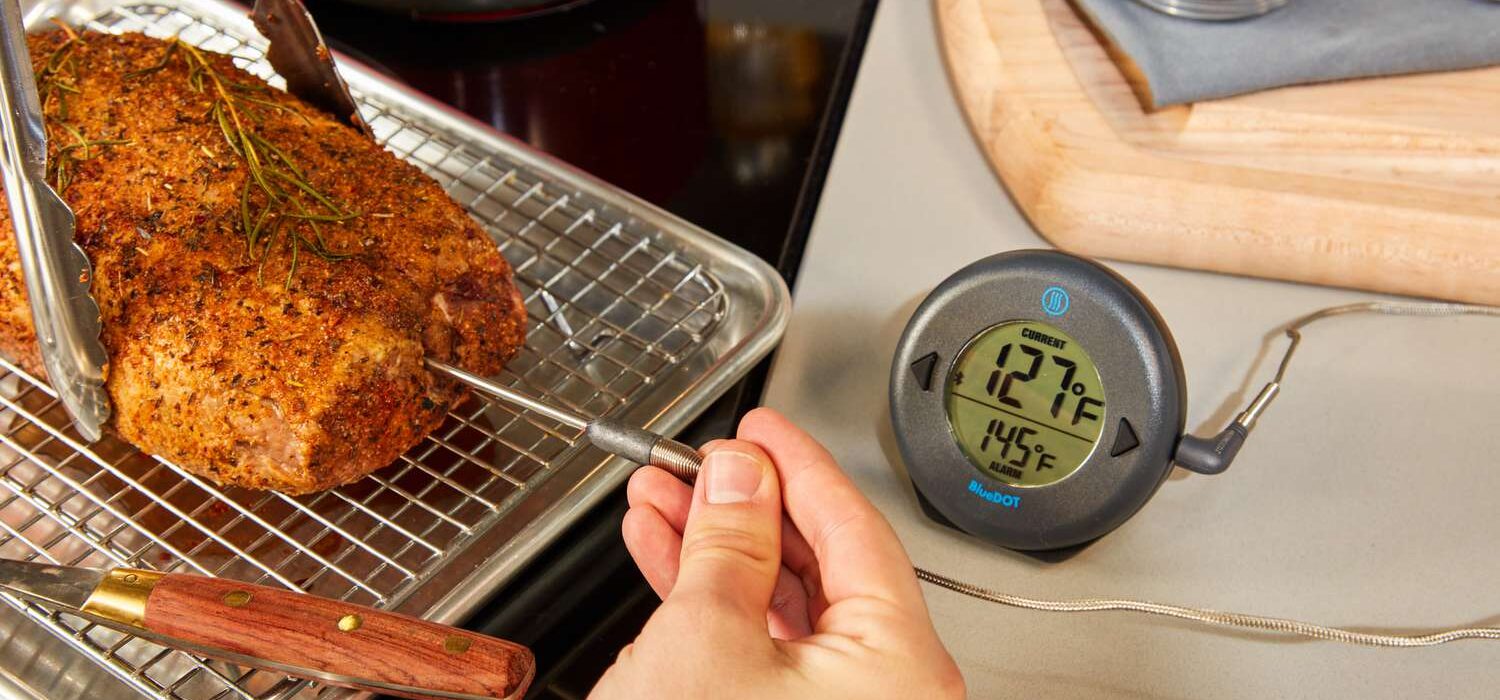
Always the thickest part, away from any bone. Bones conduct heat differently than meat and will throw off your reading. For a steak, push the probe in horizontally from the side, parallel to the grill grates. For a chicken thigh, go in the side at the thickest point, avoiding the bone. For a brisket or pork shoulder, the probe should slide in like the meat is room-temperature butter — that’s how you know it’s done.
Why is my meat thermometer showing different temps in different spots?
It’s not broken — that’s normal. Meat doesn’t cook evenly, especially on a grill. Always go by the coolest reading you find, because that’s the part that’s most undercooked. Move the probe around a few spots in the thickest section and use the lowest temp.
Can I leave a meat thermometer in the meat while it cooks?
Not these instant-read models. Instant-read thermometers are designed for spot-checks, not continuous monitoring. The plastic housings melt at sustained grill temperatures. For continuous monitoring, you need a leave-in probe thermometer with a heat-resistant cable — that’s a different product category, typically $30–$50.
Bottom line
Get the TempPro TP19H. Twenty bucks. Stop ruining steaks. The 1-second read time, IP65 waterproofing, and 3,000-hour battery make it the best value in this whole category. If you’re a serious smoker or reverse-sear cook, step up to the TP19 with thermocouple. If you want the cheapest reliable option with the best waterproofing in the roundup, get the Alpha Grillers.
You’ll never go back to eyeballing it. The first perfectly-cooked ribeye pays for the device twice over.
Related: If you’re buying this as a gift instead of for yourself, keep it simple. I included this thermometer in my last-minute Father’s Day gifts on Amazon Prime list because it is cheap, useful, and not another “World’s Best Dad” thing he has to pretend to like.